Insights · Grid connection & permits
Grid connection and permits for Data Centres in the Netherlands
For a new Data Centre in the Netherlands, the critical path rarely starts with design or construction. It starts with three questions: when is there a grid connection, is the location allowed, and which permits are needed.
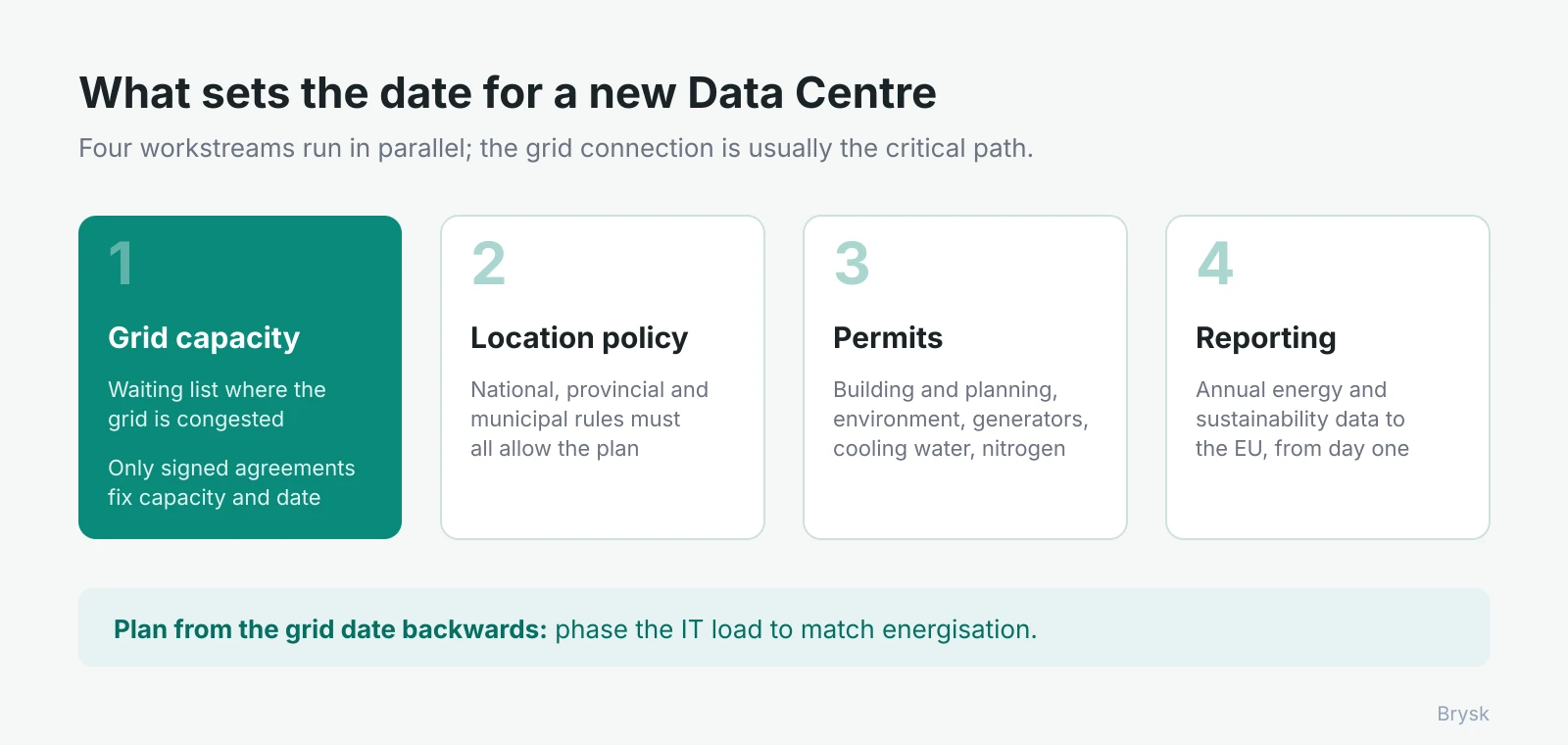
This page explains how that framework works and what it means for a programme. The principles change slowly. Figures, thresholds and dates change faster, so they are collected in the current status table, which we review regularly.
General information, not legal advice.
1. Grid capacity sets the date
Where the grid is congested (netcongestie), a request for a new or heavier grid connection (netaansluiting) goes onto the waiting list (wachtrij) of the grid operator (netbeheerder). The regulator sets the order in which freed-up capacity is allocated. That order does not create capacity: only grid reinforcement does, and new substations and high-voltage lines take many years.
A Dutch court has ruled in summary proceedings that a safe and reliable grid outweighs the interest of an individual applicant. Without signed contracts, an offer or earlier correspondence does not give an enforceable connection date.
- Only signed connection and transport agreements (aansluit- en transportovereenkomst) give certainty about capacity and dates.
- The grid date, not the construction programme, usually sets the earliest operational date.
- Phasing the IT load, on-site flexibility and non-firm contract forms can bring the first megawatts forward. Each needs to be agreed with the grid operator.
2. Where a Data Centre may be built
Location policy (vestigingsbeleid) for a Data Centre (datacenter) sits at three levels of government, and all three must allow the plan.
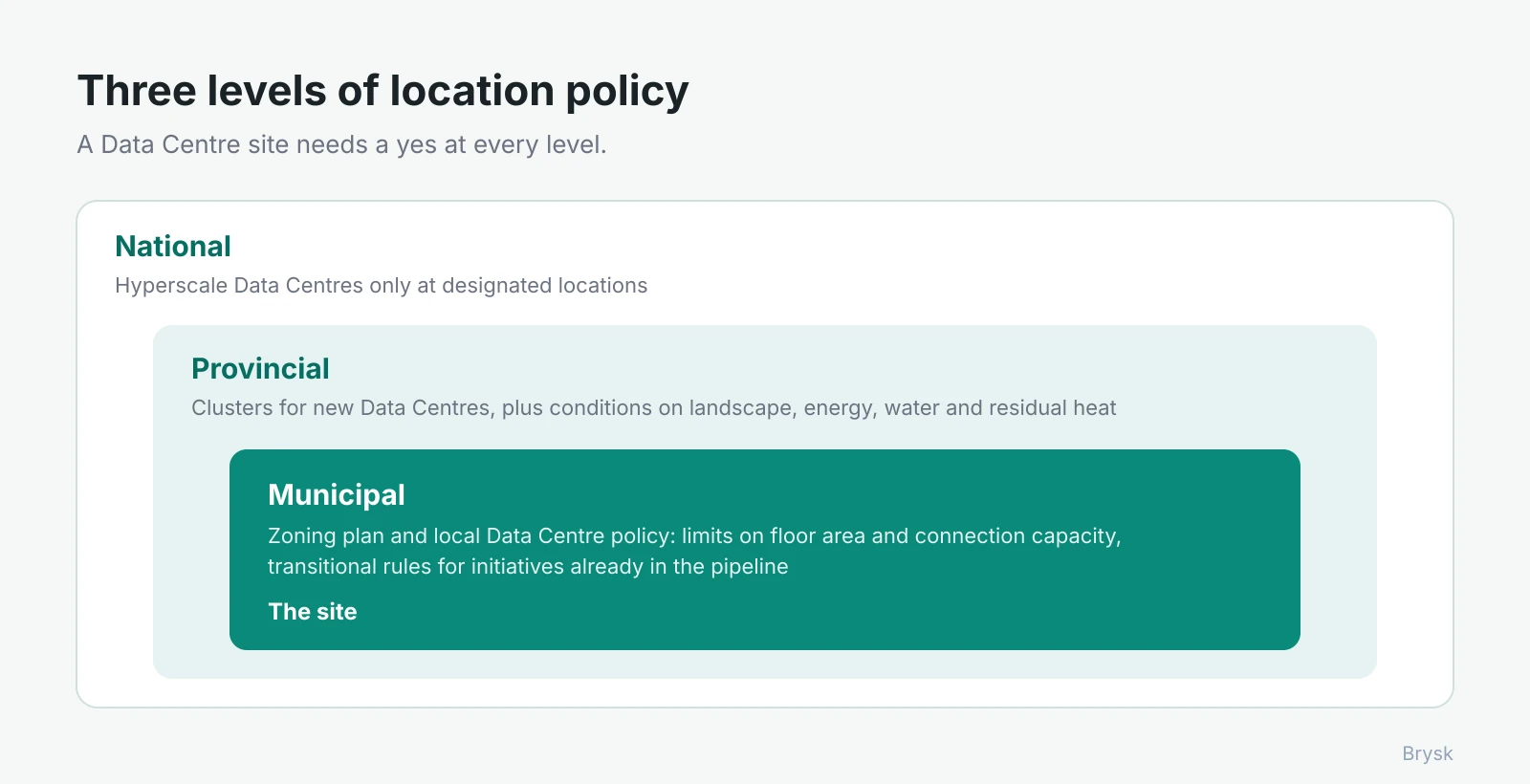
- National: the government limits very large (hyperscale) Data Centres to a few designated locations, using thresholds for site area and power demand.
- Provincial: Noord-Holland, the main Data Centre region, steers new Data Centres to designated clusters and sets conditions on landscape integration, energy, water use and residual heat (restwarmte).
- Municipal: zoning plans (bestemmingsplan, omgevingsplan) and local policies decide what is allowed on a plot. Municipalities can set their own thresholds for floor area and connection capacity, and can prohibit new Data Centres above those thresholds, as Amsterdam has done.
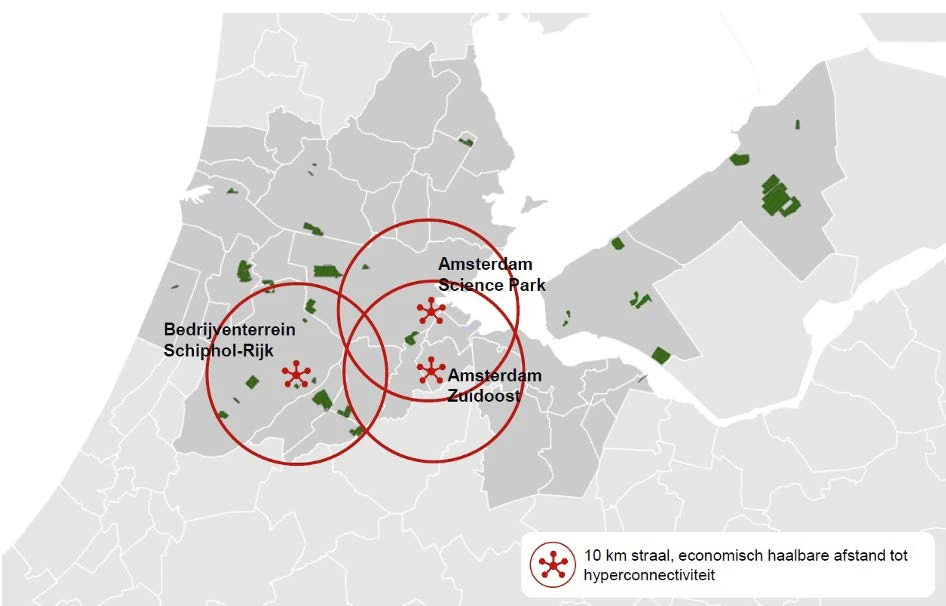
As planning space within the existing clusters runs out, policies tend to become stricter, and transitional rules often only protect initiatives that were already in the pipeline. For existing operators, upgrading within the current site and connection is then often the main route to more capacity.
Check zoning, provincial rules and municipal policy before a site is committed, and check which reference date applies to any transitional arrangement.
3. Permits under the Environment and Planning Act
Permits (omgevingsvergunning) for a Data Centre fall under the Omgevingswet (Environment and Planning Act). The thresholds below apply under the current rules; the building blocks themselves rarely change.
| Topic | What applies | Why it matters for the programme |
|---|---|---|
| Building and planning | Permit for the building activity; a planning activity if the plan does not fit the zoning | A deviation from the zoning plan adds a procedure and appeal risk |
| Environmental activity | A Data Centre is an environmentally relevant activity under paragraph 3.7.3 of the Bal | General rules apply, including energy-efficiency rules; some parts need a permit |
| Emergency generators (noodaggregaten) | Above 50 MWth thermal input, the generators make the site an IPPC installation that requires a permit | The generator plant often decides the permit route and the competent authority |
| Cooling water (koelwater) | A permit is required to discharge cooling water with a heat load above 50 MW to surface water | Relevant for water-cooled designs |
| Nitrogen (stikstof, Natura 2000) | An AERIUS calculation for construction and operation; a Natura 2000 permit may be needed if the project adds nitrogen deposition on protected habitats | Generator testing and construction traffic are typical sources |
| Environmental impact assessment (milieueffectrapportage, m.e.r.) | Required or screened depending on size and location | Adds months to the front end |
The authority, the procedure and the timeline depend on the site. Start the permit strategy alongside site selection.
4. Reporting once operational
Under the EU Energy Efficiency Directive, larger Data Centres have a reporting obligation (rapportageplicht) for energy and sustainability data, such as PUE, water use and reuse of heat, which they submit to a European database every year. In the Netherlands this runs through RVO. The threshold and deadline are in the current status table.
EU policy is moving from reporting towards rating and minimum performance standards. Metering and data collection are easiest to design in from the start, not to retrofit.
5. What this means for the programme
In the Dutch market, the grid connection and the permits usually set the critical path. A realistic programme therefore:
- Confirms grid capacity, location policy and zoning before the investment decision, as part of the feasibility advice.
- Treats the grid connection as a separate workstream, with its own milestones, contracts and risk register.
- Starts the permit strategy during site selection, including generators, nitrogen and cooling.
- Phases the IT load so that construction and commissioning can match the energisation dates.
- Builds the reporting and metering requirements into the design brief.
Brysk advises clients on this at the site and feasibility stage, and manages the grid and permit workstreams through to handover.
Current status
Reviewed: November 2026.
| Grid allocation | Large parts of the Netherlands are congested. Since 1 July 2026 there is one waiting list for small and large users, ordered by the ACM’s prioritisation framework (maatschappelijk prioriteringskader), in force since 1 January 2026. |
|---|---|
| Grid in Noord-Holland | TenneT and Liander expect congestion to be resolved between 2033 and 2036. Several Data Centre requests around Vijfhuizen were paused in 2026. |
| National hyperscale rules | Hyperscale Data Centres (larger than 10 ha with a connection of 70 MW or more) are only allowed in Eemshaven and Middenmeer. |
| Noord-Holland | Datacenterstrategie 2025–2027: Data Centres above 2,000 m² and/or 5 MVA only in clusters in Amsterdam, Haarlemmermeer and Hollands Kroon; no new hyperscale initiatives. |
| Amsterdam | Umbrella zoning plan (paraplubestemmingsplan) “Datacenters Amsterdam”: no new or expanded Data Centres above 2,000 m² gross floor area and 5 MVA connection capacity; exceptions only for initiatives with an application or pre-consultation started before 28 December 2023; review after 2035. Plan amended 2 September 2026. |
| EU reporting | Data Centres with 500 kW or more installed IT power report every year by 15 May. An EU rating scheme and label have been proposed. |
Sources: ACM · Rechtspraak · Provincie Noord-Holland · Gemeente Amsterdam · IPLO · RVO
Frequently asked questions
How long does a new grid connection for a Data Centre take?
In congested regions it can take years, because new capacity depends on grid reinforcement. The grid operator can give a written indication for a specific location; ask for it before the investment decision.
Can a hyperscale Data Centre still be built in the Netherlands?
Only at the locations designated in national policy. Which sites and thresholds apply is listed in the current status table on this page.
Do emergency generators affect the permit?
Yes. Above a set thermal input, the generators make the site an installation that requires an environmental permit. Testing hours and emissions also feed into the nitrogen calculation.
Which Data Centres must report under the Energy Efficiency Directive?
Data Centres above an installed IT power threshold. They report every year to the European database; the current threshold and deadline are in the current status table.
Can a new Data Centre still be built in Amsterdam?
Under the current umbrella zoning plan, in principle not above a set floor area and connection capacity. Check the current status table and the plan itself for the exact limits and exceptions.
Written by Rutger Truffino, Managing Partner at Brysk. Brysk manages Data Centre projects in the Amsterdam region and across Europe. LinkedIn · Our projects
Planning a Data Centre in the Netherlands?
Discuss your site
Mission critical project management for Data Centres and infrastructure across Europe.
Contact
- Unit D1.8, H.J.E. Wenckebachweg 123, 1096 AM Amsterdam
- Registered office: Nijkerkerstraat 69, 3882 PD Putten
- info@brysk.nl · Follow us on LinkedIn